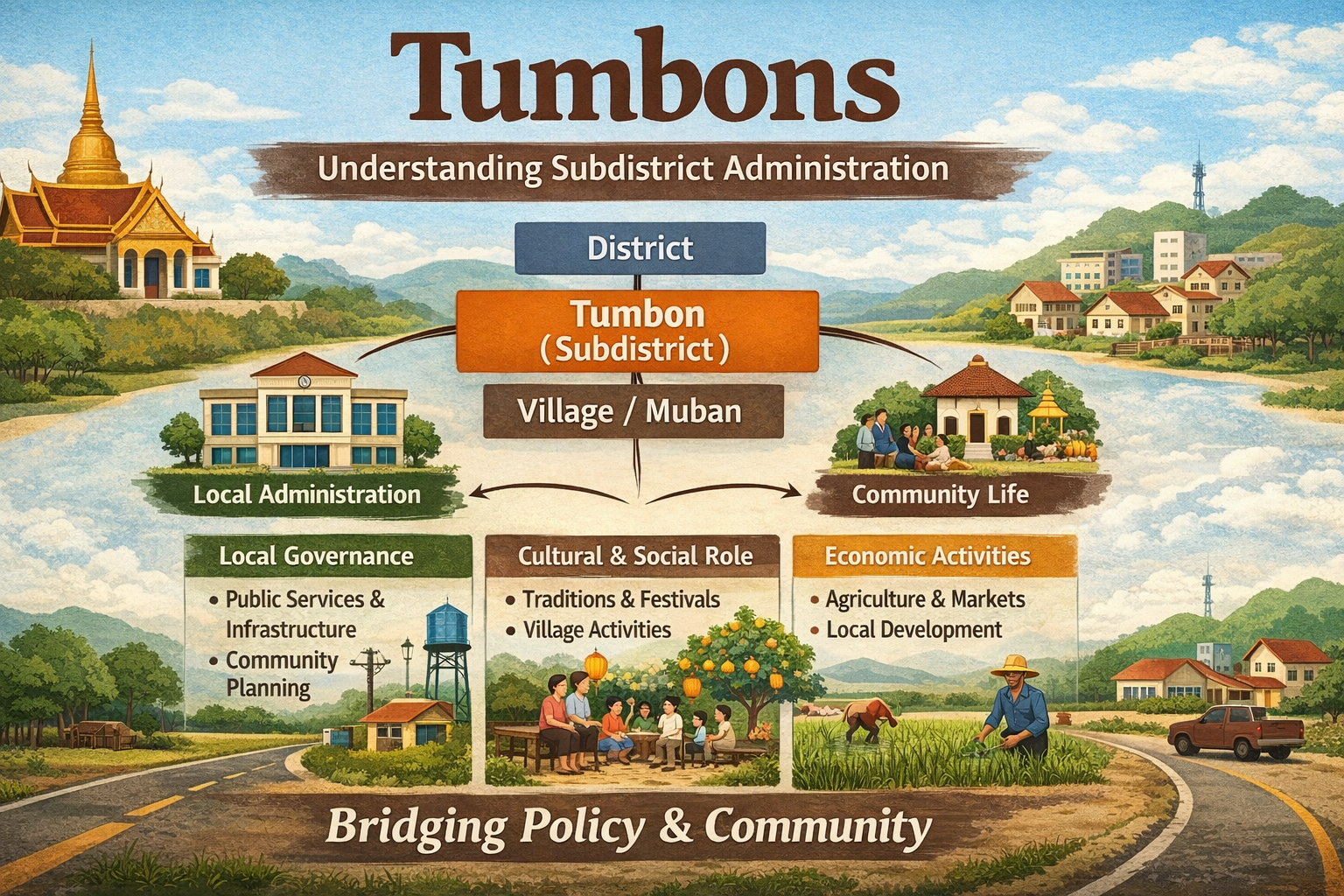
Tumbons: A Deep Exploration of Subdistrict Administration and Local Governance
Introduction to Tumbons
The concept of Tumbons represents a foundational layer within multi-tier administrative systems used to manage populations, land, and local governance. Although the spelling “tumbons” is commonly encountered in English-language searches, it broadly refers to a subdistrict-level administrative unit designed to operate between larger governing divisions and smaller community units. Tumbons exist to ensure that governance remains close to the people while still aligning with higher administrative authority.
Rather than functioning as abstract boundaries on a map, tumbons are practical governance spaces where administrative responsibility, community organization, and development planning intersect. They serve as a mechanism through which policies are localized, services are delivered, and communities are formally recognized within a structured system of governance.
Defining the Administrative Meaning of Tumbons
At an administrative level, tumbons function as intermediate governance units. They sit between higher-level districts and the smallest community units, often villages or neighborhoods. This positioning allows tumbons to manage localized concerns while maintaining coordination with broader administrative goals.
Why Subdistrict-Level Administration Exists
The existence of tumbons is rooted in administrative efficiency and social practicality. Governing large territories exclusively from central or regional authorities often leads to gaps in service delivery and weak community engagement. Tumbons reduce this distance by creating governance units that are small enough to understand local needs but large enough to manage shared resources and infrastructure.
Structural Position of Tumbons in Governance Systems
Tumbons operate within hierarchical administrative frameworks designed to distribute authority and responsibility across multiple levels. While higher divisions focus on policy direction and regional planning, tumbons concentrate on implementation and community coordination.
Relationship Between Tumbons and Local Communities
Within each tumbon are multiple smaller settlements that maintain their individual identities while sharing administrative oversight. This structure promotes cooperation among communities, allowing them to benefit from shared services such as transportation networks, water systems, and public facilities.
Historical Development of Tumbons
The emergence of tumbons can be traced to traditional patterns of settlement and land management. Early communities often organized themselves around shared natural resources, trade routes, and social institutions. Over time, these informal groupings were incorporated into formal administrative systems.
From Informal Communities to Formal Administration
As governance systems evolved, there was a need to standardize local administration without disrupting existing social structures. Tumbons provided a solution by formalizing community groupings that already functioned as cohesive units. This process preserved social continuity while enabling administrative modernization.
Governance Functions at the Tumbon Level
Tumbon-level governance is primarily concerned with local administration, service coordination, and development planning. Administrative bodies at this level operate within legal frameworks defined by higher authorities but retain flexibility in addressing local priorities.
Decision-Making and Administrative Authority
Local decision-making within tumbons typically focuses on practical concerns such as infrastructure maintenance, public facilities, and community welfare initiatives. Because administrators are closely connected to the communities they serve, decision-making tends to be more responsive and context-sensitive.
The Role of Tumbons in Public Service Delivery
One of the most significant functions of tumbons is their role in delivering public services. These services often include local infrastructure development, environmental management, sanitation, and community health support.
Bridging Policy and Practice
Tumbons act as a bridge between policy formulation and real-world application. Policies designed at higher administrative levels rely on tumbon-level structures for effective execution, ensuring that programs are adapted to local conditions rather than applied uniformly.
Social Importance of Tumbons
Beyond administration, tumbons play an important social role. They often define the boundaries within which social interaction, cooperation, and collective identity develop.
Community Identity and Social Cohesion
Residents within a tumbon frequently share social networks, cultural practices, and communal spaces. This shared environment fosters cooperation and reinforces a sense of belonging, making tumbons important not only administratively but also socially.
Cultural Dimensions of Tumbons
Cultural life within tumbons is shaped by long-standing traditions and shared practices. Festivals, ceremonies, and communal activities are often organized at the tumbon level, reinforcing cultural continuity.
Preservation of Local Traditions
By aligning administrative boundaries with culturally meaningful communities, tumbons help preserve traditions while supporting modern governance. This balance allows cultural expression to coexist with administrative efficiency.
Economic Significance of Tumbons
Economically, tumbons function as localized economic units. They often reflect the dominant livelihoods of their communities, whether agriculture, trade, services, or small-scale industry.
Supporting Local Economic Activity
Administrative coordination at the tumbon level helps support economic development through infrastructure improvement, market access, and community-based initiatives. These efforts strengthen local economies and improve overall living standards.
Tumbons and Decentralized Governance
Tumbons are central to decentralization strategies aimed at empowering local communities. By transferring certain responsibilities to the subdistrict level, governance systems become more inclusive and adaptable.
Encouraging Local Participation
Decentralized governance through tumbons encourages residents to participate in decision-making processes. This participation enhances accountability and ensures that development initiatives reflect genuine community needs.
Variations Among Tumbons
Not all tumbons operate under identical conditions. Differences in population density, geography, and economic activity result in varied administrative challenges and priorities.
Adapting Governance to Local Conditions
The flexibility of the tumbon system allows each unit to adapt its governance approach. This adaptability is a key strength, enabling tumbons to remain effective across diverse environments.
Contemporary Challenges Facing Tumbons
Despite their importance, tumbons face challenges such as limited resources, administrative capacity constraints, and changing social dynamics. Urban expansion and demographic shifts further complicate governance at this level.
Managing Change While Maintaining Stability
Balancing modernization with community stability is an ongoing challenge. Strengthening administrative capacity and improving coordination with higher governance levels are essential for sustaining tumbon effectiveness.
The Future Role of Tumbons
As governance systems continue to evolve, tumbons are likely to assume new responsibilities related to technology, sustainability, and community development.
Innovation and Local Governance
Future tumbons may incorporate digital tools, data-driven planning, and participatory governance models. These innovations can enhance transparency, efficiency, and community engagement.
Conclusion
Tumbons represent a critical layer of governance that connects administrative systems with everyday community life. They transform abstract policy into practical action, support social cohesion, and promote localized development. By combining historical continuity with administrative structure, tumbons demonstrate how subdistrict-level governance can remain both effective and people-centered.
A deeper understanding of tumbons offers valuable insight into how decentralized administration supports social stability, economic growth, and responsive governance. As systems adapt to modern challenges, tumbons will continue to play a vital role in shaping sustainable and inclusive communities.