SOA OS23: Modern Evolution of Service-Oriented Architecture
SOA OS23 is redefining how modern enterprises approach system design in the rapidly evolving software development landscape. Architecture today is no longer just about organizing code—it serves as the backbone that determines how systems scale, adapt, and respond to continuous technological change. Over the past two decades, Service-Oriented Architecture (SOA) has significantly influenced the way organizations design enterprise software. Traditional SOA emphasizes modular, reusable services that communicate through standardized interfaces, allowing businesses to build flexible, maintainable, and integrated applications that can evolve alongside their operational needs.
With the rise of cloud computing, AI, and distributed systems, SOA has evolved into a modern framework known as SOA OS23 (Service-Oriented Architecture Open Standard 2023). This architecture builds upon traditional SOA principles but incorporates modern design practices to address today’s technology and business needs.
Understanding Service-Oriented Architecture (SOA)
Service-Oriented Architecture is a software design approach that organizes functionality into discrete services. Each service encapsulates a specific business function and communicates with other services through well-defined interfaces. Traditional SOA was developed to tackle challenges in monolithic enterprise applications, such as difficulty in scaling, integrating, and maintaining large codebases.
The foundational principles of classical SOA include:
- Loose Coupling: Services operate independently, minimizing dependencies on other components.
- Reusability: Services can be reused across different applications or business processes.
- Interoperability: Services can communicate across various platforms, languages, and environments.
- Standardized Communication: Services rely on protocols such as SOAP, XML, or REST for predictable interactions.
While these principles provided flexibility and maintainability, traditional SOA often suffered from heavy middleware, complex governance requirements, and slower deployment cycles. These limitations paved the way for a modernized version—SOA OS23.
What is SOA OS23?
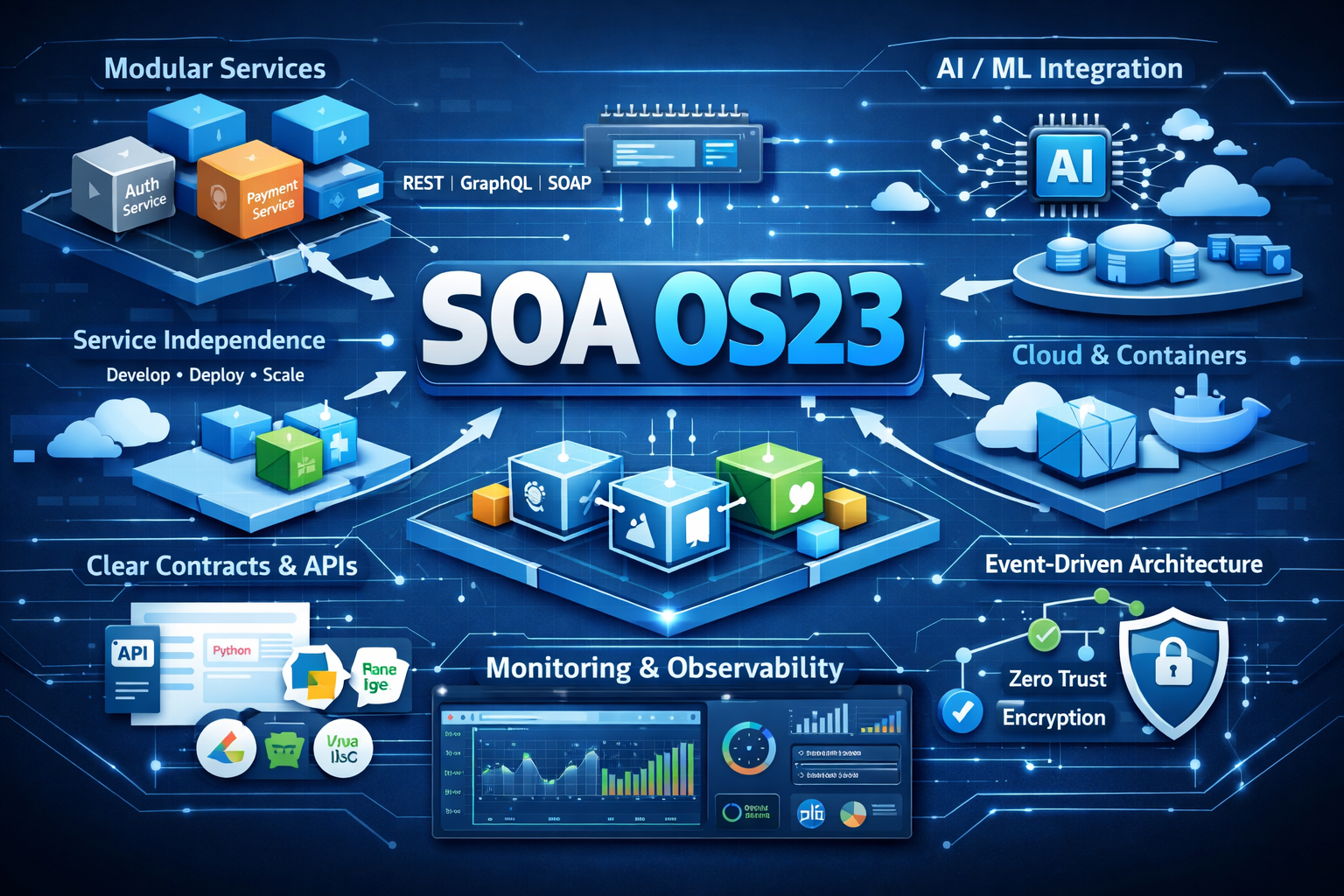
It represents the 2023 evolution of service-oriented design. It adapts classical SOA principles to modern technology trends, including cloud-native environments, AI integration, and microservices-oriented workflows. Unlike monolithic systems, where all functionality is tightly coupled, it employs a modular approach. Each service focuses on a single business task, such as authentication, payment processing, or data retrieval. These services are independent but communicate seamlessly through standardized APIs.
The “23” in SOA OS23 indicates its version year, reflecting updates such as:
- Enhanced Security: Zero-trust policies, multi-factor authentication, and end-to-end encryption.
- AI/ML Integration: Built-in support for machine learning models and AI-driven service orchestration.
- Cloud and Container Support: Designed for seamless deployment across private, public, hybrid, and edge environments.
- Flexible Governance: Distributed governance models that minimize centralized bottlenecks.
It does not replace classical SOA; instead, it extends it to meet the demands of modern enterprise systems. It is particularly suitable for organizations undergoing digital transformation, leveraging AI, or implementing cloud-native infrastructure.
Core Principles of SOA OS23
It retains the essence of classical SOA while introducing enhancements for today’s software landscape:
Modularity
Modularity is the practice of breaking down a large application into smaller, independent services. Each service handles a specific business function, like authentication or payment processing. This approach allows teams to develop, maintain, or update services individually without affecting the whole system. It also makes it easier to reuse services across multiple applications, speeding up development and reducing redundancy.
Service Independence of SOA OS23
Service independence ensures that each service operates autonomously. This means you can deploy, scale, or update one service without needing to restart or modify other services in the system. Independent services reduce the risk of failures cascading across the architecture and allow teams to work in parallel, which accelerates delivery and improves system resilience.
Clear Contracts and APIs
In SOA OS23, services communicate through well-defined interfaces or “contracts.” These contracts are typically implemented as APIs using REST, GraphQL, SOAP, or gRPC protocols. Clear contracts guarantee predictable and consistent communication between services, so one service knows exactly how to interact with another. This reduces errors and simplifies integration, even when services are built in different languages or platforms.
Reusability and Composability
Reusability means that once a service is built, it can be reused in multiple applications or workflows. Composability allows these services to be combined to create larger, more complex workflows or entirely new applications. Together, these principles make the architecture flexible, allowing businesses to innovate quickly without rebuilding functionality from scratch.
Interoperability
It is designed to work across various programming languages, operating systems, and platforms. This means services written in Python, Java, Node.js, or Go can communicate seamlessly. Interoperability ensures that different teams, technologies, or even legacy systems can integrate into a unified service-oriented ecosystem.
Event-Driven Architecture of SOA OS23
Event-driven architecture allows services to respond to events as they happen in real time. For example, a payment service could automatically trigger an order fulfillment service when a transaction completes. This reactive approach enables dynamic workflows, faster decision-making, and better responsiveness, making systems more agile and efficient.
Architecture Components of SOA OS23
A typical implementation consists of multiple components working together to deliver reliable, scalable, and secure services:
- Service Providers: Individual services that execute specific business functions. Examples include payment gateways, authentication modules, or data retrieval services.
- Service Consumers: Applications or other services that use the functionality provided by service providers.
- Communication Layer: Handles service messaging, protocol translation, routing, and API management.
- Orchestration Tools: Ensure complex workflows involving multiple services execute correctly and efficiently.
- Governance and Monitoring: Includes service versioning, lifecycle management, policy enforcement, and observability tools.
- Integration Modules: Middleware and adapters to connect modern services with legacy systems.
Together, these components create a robust ecosystem where independent services interact smoothly while remaining loosely coupled.
Key Features of SOA OS23
It introduces several modern features that distinguish it from traditional SOA:
- Modular Service Design: Services are small, self-contained, and reusable. This speeds up development, allows easier updates, and reduces system-wide risk.
- API-First Communication: APIs are the primary interface for service interaction. it supports REST, GraphQL, SOAP, and other protocols while enabling API gateways with load balancing, versioning, and security enforcement.
- Cloud-Native Compatibility: SOA OS23 is optimized for containerized deployments using Kubernetes and Docker. Services can scale horizontally and vertically across private, public, and hybrid clouds.
- Built-in Observability: Logging, metrics, and tracing are integrated, enabling real-time monitoring of system performance. Tools like Prometheus, Grafana, and OpenTelemetry are supported.
- Zero-Trust Security Model: Every request is verified. Access is limited using least-privilege policies, and communication is encrypted end-to-end.
- AI/ML Integration: Supports machine learning workflows, predictive analytics, and AI-driven service orchestration.
- Multi-Environment Support: Designed to run in diverse environments, from cloud to edge computing devices, without code modification.
How SOA OS23 Works
It operates on a microservices-based architecture. Each service performs a distinct function and communicates through standardized APIs. The flow of operations typically includes:
- A consumer requests data or a function from a service.
- The service processes the request independently, executes its task, and returns a response.
- Communication protocols such as REST, GraphQL, SOAP, JMS, or Apache Thrift handle the message exchange.
- Orchestration tools coordinate services for complex workflows, ensuring smooth end-to-end execution.
- Security protocols like JWT tokens, AES256 encryption, and access policies protect every interaction.
- Monitoring frameworks track performance, detect anomalies, and provide actionable insights.
This approach ensures flexibility, reliability, and security while minimizing dependencies between services.
Benefits of SOA OS23 Architecture
Adopting it offers tangible benefits for modern enterprises:
Faster Development and Deployment
By reusing modular services and standardized APIs, development teams can deploy new features faster. Parallel development reduces bottlenecks, while prebuilt compliance and security templates accelerate delivery.
Improved System Resilience
Fault isolation ensures that failures in one service do not cascade through the system. Rollback capabilities, version control, and sandboxed environments further enhance stability.
Seamless Integration with Legacy Systems
SOA OS23 integrates smoothly with existing infrastructure through middleware translation layers and prebuilt connectors. Organizations can modernize gradually without replacing legacy systems.
Scalability Across Cloud and Edge
The architecture dynamically allocates CPU, memory, and bandwidth based on workload. Services scale horizontally and vertically, supporting distributed cloud and edge deployments.
Enhanced Business Agility of SOA OS23
Independent services can be recombined to create new workflows or applications rapidly. This enables organizations to respond quickly to market changes and customer demands.
Strong Security and Compliance
Zero-trust models, encrypted communication, role-based access, and auditing ensure secure operations across the entire service ecosystem.
Real-World Use Cases of SOA OS23
Large enterprises modernize legacy systems using it. Modular services allow departments to innovate independently while maintaining enterprise-wide cohesion. Business process automation benefits efficiency in finance, logistics, and retail.
Healthcare Data Exchange
Hospitals, labs, and insurance providers use SOA OS23 to securely share patient data. Compliance with HIPAA and HL7 standards is maintained while enabling telemedicine, patient portals, and real-time data exchange.
IoT and Edge Computing
Manufacturers deploy it for distributed IoT devices. Microservices-based workflows reduce latency and optimize bandwidth while supporting live automation, predictive maintenance, and smart manufacturing.
Financial Services Integration
Banks and fintech companies use SOA OS23 to connect legacy systems with mobile apps and blockchain networks. KYC microservices, fraud detection engines, and payment gateways operate reliably with minimal downtime.
Smart Manufacturing
Industry 4.0 environments leverage it to connect machines, processes, and supply chains. Services dynamically adjust workflows based on real-time data from edge devices, improving efficiency and reducing operational costs.
Emerging Trends and the Future of SOA OS23
AI-Driven Service Orchestration
AI is increasingly used to manage service interactions, optimize workflows, and automate decision-making. Self-adaptive SOA capabilities will allow services to adjust dynamically based on changing business conditions.
Blockchain Integration
SOA OS23 integrates blockchain to provide immutable audit trails, decentralized coordination, and smart contract automation. This enhances security, compliance, and transparency in distributed systems.
Digital Credentialing
Organizations can track and verify certifications and access rights across services, ensuring compliance and simplifying operational oversight.
API Standardization and Service Mesh
Standardized APIs, sidecar proxies, distributed tracing, and failover mechanisms will become standard features. SOA OS23 will increasingly blend with serverless, cloud-native, and event-driven architectures.
Challenges of SOA OS23
Despite its advantages, it introduces some challenges:
- Complexity: Managing multiple independent services requires skilled teams and careful planning.
- Network Dependency: Service communication relies on stable, high-performance networks.
- Governance Overhead: Proper monitoring and lifecycle management are critical to prevent fragmentation.
- Learning Curve: Transitioning from monolithic or older SOA systems demands training and organizational change.
Understanding these challenges is essential for successful implementation.
Why SOA OS23 Still Matters
Even with newer architectural paradigms, it remains relevant. By combining classical SOA principles with modern development practices, it strikes a balance between structure and flexibility. It supports digital transformation, business agility, cloud-native strategies, and AI-driven systems—ensuring enterprises remain adaptable and innovative.
Conclusion
It represents the next generation of service-oriented design. It builds on decades of SOA experience while addressing the demands of cloud-native computing, AI integration, and modular development. Its microservices-based, API-driven, and secure architecture enables faster development, improved resilience, seamless integration, and scalability across modern infrastructures.
From enterprise IT systems to healthcare, IoT, financial services, and smart manufacturing, SOA OS23 proves that service-oriented thinking is as relevant today as ever. As digital ecosystems continue to evolve, it will remain a cornerstone for building flexible, resilient, and future-ready applications.
By adopting it, organizations gain a robust framework that blends traditional principles with modern innovation—empowering them to thrive in a rapidly changing technology landscape.